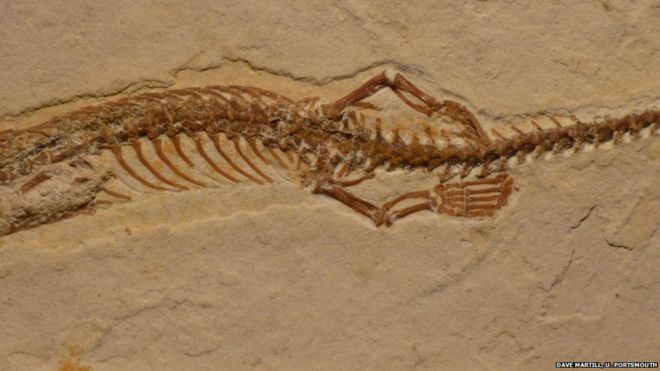
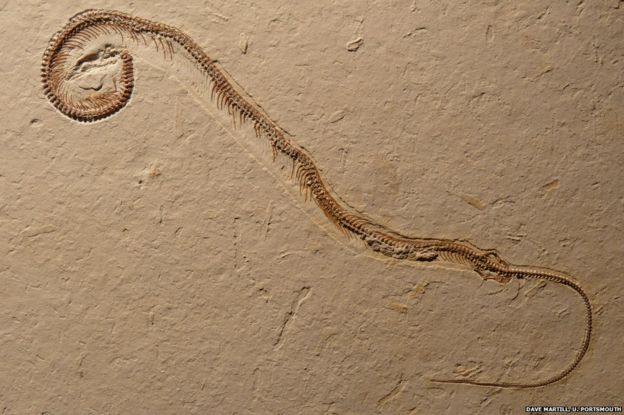
A 113-million-year-old fossil from Brazil is the first four-legged snake that scientists have ever seen.
Several other fossil snakes have have been found with hind limbs, but the new find is estimated to be a direct ancestor of modern snakes.
Its delicate arms and legs were not used for walking, but probably helped the creature to grab its prey.
The fossil shows adaptations for burrowing, not swimming, strengthening the idea that snakes evolved on land.
That debate is a long-running one among palaeontologists, and researchers say wiggle-room is running out for the idea that snakes developed from marine reptiles.
"This is the most primitive fossil snake known, and it's pretty clearly not aquatic," said Dr Nick Longrich from the University of Bath, one of the study's authors.
Speaking to Science in Action on the BBC World Service, Dr Longrich explained that the creature's tail wasn't paddle-shaped for swimming and it had no sign of fins; meanwhile its long trunk and short snout were typical of a burrower.
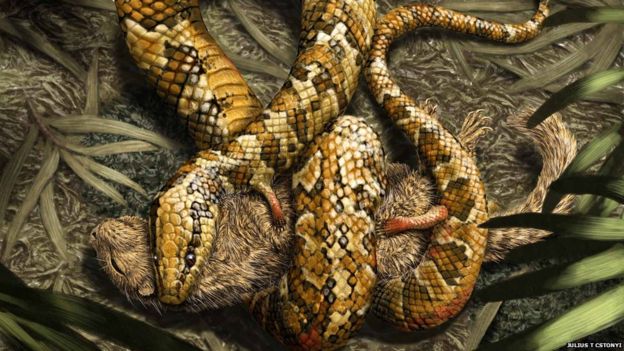
"It's pretty straight-up adapted for burrowing," he said.
When Dr Longrich first saw photos of the 19.5cm fossil, now christened, he was "really blown away" because he was expecting an ambiguous, in-between species.
Instead, he saw "a lot of very advanced snake features" including its hooked teeth, flexible jaw and spine - and even snake-like scales.
"And there's the gut contents - it's swallowed another vertebrate. It was preying on other animals, which is a snake feature.
"It was pretty unambiguously a snake. It's just got little arms and little legs."

Deadly embrace?

At 4mm and 7mm long respectively, those arms and legs are little indeed. But Dr Longrich was surprised to discover that they were far from being "vestigial" evolutionary leftovers, dangling uselessly.
"They're actually very highly specialised; they have very long, skinny fingers and toes, with little claws on the end. What we think [these animals] are doing is they've stopped using them for walking and they're using them for grasping their prey."
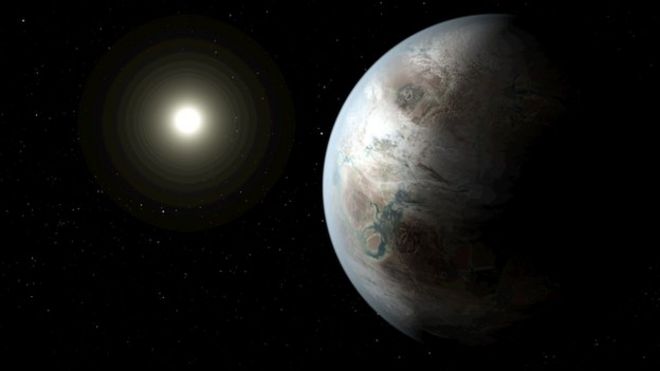
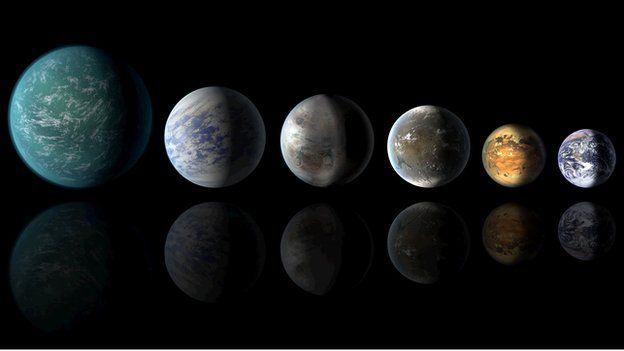
A haul of planets from Nasa's Kepler telescope includes a world sharing many characteristics with Earth.
Kepler-452b orbits at a very similar distance from its star, though its radius is 60% larger.
Mission scientists said they believed it was the most Earth-like planet yet.
Such worlds are of interest to astronomers because they might be small and cool enough to host liquid water on their surface - and might therefore be hospitable to life.


Nasa's science chief John Grunsfeld called the new world "Earth 2.0" and the "closest so far" to our home.
It is around 1,400 light years away from Earth.

John Jenkins, Kepler data analysis lead at Nasa's Ames Research Center in California, added: "It's a real privilege to deliver this news to you today. There's a new kid on the block that's just moved in next door."
The new world joins other exoplanets such as Kepler-186f that are similar in many ways to Earth.

Determining which is most Earth-like depends on the properties one considers. Kepler-186f, announced in 2014, is smaller than the new planet, but orbits a red dwarf star that is significantly cooler than our own.
Kepler-452b, however, orbits a parent star which belongs to the same class as the Sun: it is just 4% more massive and 10% brighter. Kepler-452b takes 385 days to complete a full circuit of this star, so its orbital period is 5% longer than Earth's.
The mass of Kepler-452b cannot be measured yet, so astronomers have to rely on models to estimate a range of possible masses, with the most likely being five times that of Earth. If it is rocky, the world would likely still have active volcanism and its gravity would be roughly twice that on our own planet.
The new world is included in a haul of 500 new possible planets sighted by the Kepler space telescope around distant stars.


Twelve of the new candidates are less than twice Earth's diameter, orbiting in the so-called habitable zone around their star.
This zone refers to a range of distances at which the energy radiated by the star would permit water to exist as a liquid on the planet's surface if certain other conditions are also met.
Of these 500 candidates, Kepler-452b is the first to be confirmed as a planet.
Dr Suzanne Aigrain, from the University of Oxford, who was not involved with the study, told BBC News: "I do believe the properties described for Kepler-452b are the most Earth-like I've come across for a confirmed planet to date.
"What seems even more significant to me is the number of planets in the habitable zone of their host stars with radii below two Earth radii; 12 is quite a few compared to the pre-existing Kepler planet catalogue.
"It bodes well for their attempts to provide a more robust measure of the incidence of Earth-like planets, which is the top-level goal of the Kepler mission."


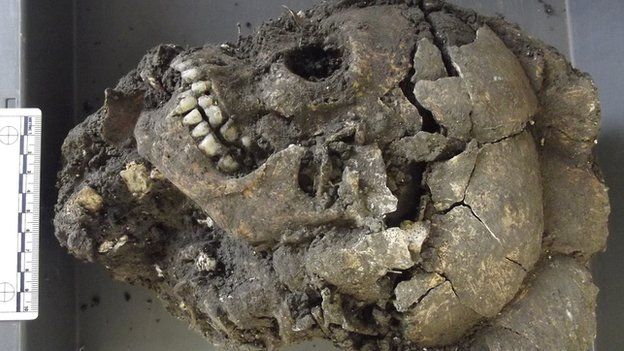
A 4,000-year-old Bronze Age skeleton, believed to be that of a child, has been unearthed by archaeologists at a dig in Wiltshire.
The team from the University of Reading made the discovery while excavating Wilsford henge in the Vale of Pewsey.
The body was found lying in a foetal position and wearing an amber necklace.
Reading University archaeologist Dr Jim Leary described the skeleton as a "wonderful discovery".
He said: "Scientific analysis will provide information on the gender of the child, diet, pathologies and date of burial.
"It may also shed light on where this young individual had lived."
The three-year Vale of Pewsey dig is a partnership between the University of Reading, Historic England, the Arts and Humanities Research Council and Wiltshire Museum.
The aim is to gain a better understanding of the people who lived in the areas surrounding Stonehenge.
Findings to date include flint arrowheads and blades, decorated pottery, shale and copper bracelets and a Roman brooch.

During the last six weeks the team has focused on Marden henge and Wilsford henge.
Dr Leary said: "Finds from the first five weeks of the dig were exciting - but as so often during excavations the best is revealed last."
Built in 2,400 BC, Marden henge is the largest prehistoric monument of its kind in the country.
Duncan Wilson, of Historic England, said: "Bigger than Avebury, 10 times the size of Stonehenge and halfway between the Stonehenge and Avebury World Heritage Sites, comparatively little is known about this fascinating and ancient landscape.
"The work will help Historic England focus on identifying sites for protection and improved management, as well as adding a new dimension to our understanding of this important archaeological environment."


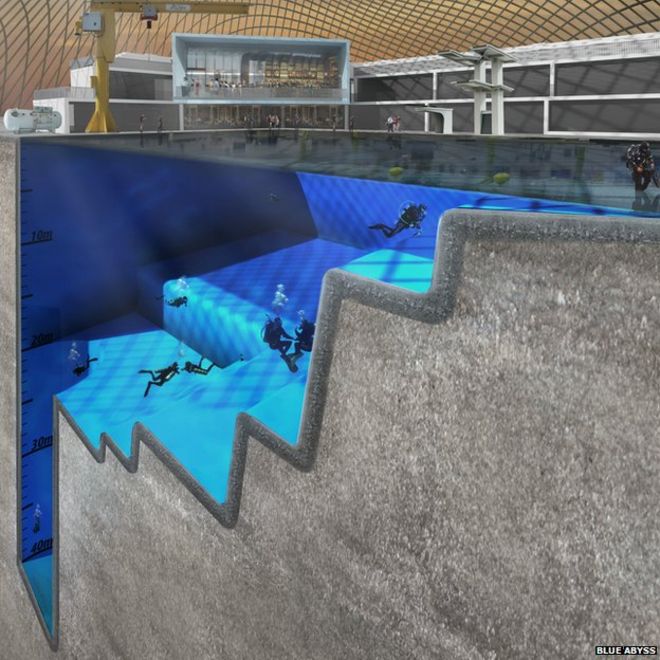
A university is in "exploratory discussions" to build the world's deepest swimming pool for spaceflight and human endurance research.
The proposed 50m (164ft) deep pool at the University of Essex would be far deeper than NASA's own 12m (40ft) deep training pool in Houston.
If it goes ahead, the project is expected to cost £40m.
The pool would simulate the microgravity of outer space and deep sea environments.
The university's development partner Blue Abyss said the pool could be used for human spaceflight research programmes, environmental monitoring, training in advanced commercial diving techniques, marine and human physiology research and aerospace development.
The world's current deepest pool is the Y-40 diving pool in Montegrotto Terme, Italy, which is 42m (137ft) deep.


Deep water

  • In 2008, Vittorio Innocente rode a bicycle at a depth of 67m (219ft)
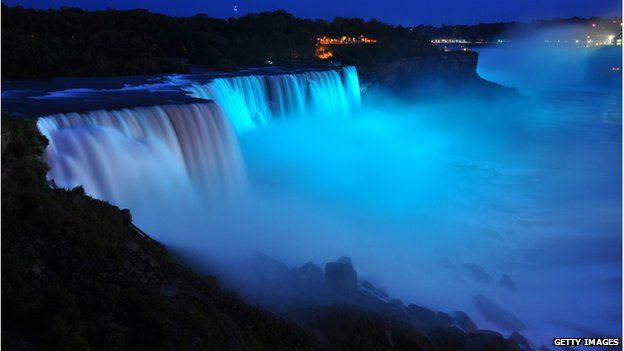
  • The plunge pool under Niagara Falls is 35m (114ft), nearly two-thirds of the height of the falls themselves.
  • The standard Olympic diving pool is 5m (16ft) deep
  • Loch Morar is the UK's deepest body of water, dropping to a depth of 310m
line
John Vickers, managing director of Blue Abyss, said: "All the ingredients are here; the location near to Stansted Airport and the North Sea offshore industry via Harwich; a superb campus site and an excellent research base within the University's academic departments."
University of Essex registrar Bryn Morris said the pool idea, on the Knowledge Gateway research and business park, fitted in "very well" with the university's "strengths".