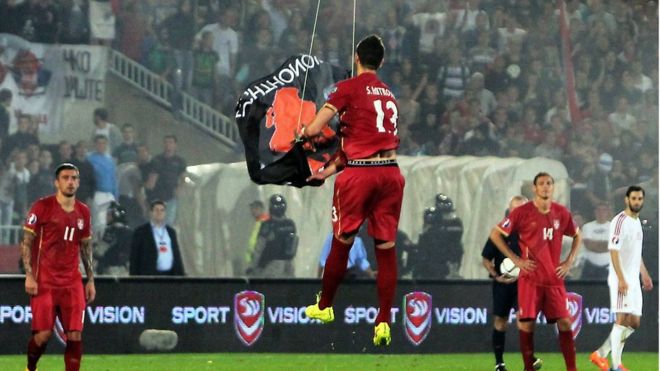
A man who flew a drone into a football stadium in Serbia during a Euro 2016 qualifier last October has been arrested ahead of the return leg in Albania.
Ismail Morinaj was detained after giving an interview in which he admitted carrying a gun for protection.
Last year's match had to be abandoned as Serbian fans invaded the pitch and attacked Albanian players.
Security for the Serbia team is high in Albania before Thursday's match.
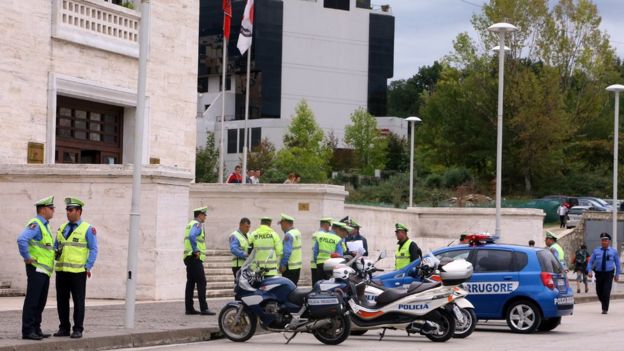
Although the match will take place in Elbasan, an hour's drive to the south-east of Tirana, the Serbia team are staying at a hotel in the capital surrounded by police.
Reports from Tirana spoke of roads inside the city being closed amid a major police operation.
Albania are third in their Euro 2016 qualifying group, behind Portugal and Denmark, but far ahead of Serbia and still hoping to qualify for the knock-out stages of the competition.
Police arrested the 33-year-old suspect and three other men, saying they had found a Zastava pistol and several cartridges, as well as 36 tickets for Thursday's match.
Tensions had already been high before the Euro 2016 tie at the Partizan Stadium in Belgrade and ordinary Albanian fans were not allowed to attend the match.
The two countries have had a long and bitter history of rivalry, and ethnic-Albanian-majority Kosovo's decision to declare independence from Serbia in 2008 brought relations to a new low.
Ismail Morinaj admitted flying the drone from a church across the road from the stadium. As it hovered above the pitch, a large "greater Albania" flag could be seen, portraying nationalist claims to neighbouring states.


Fifa president Sepp Blatter is facing a 90-day provisional suspension.
Members of Fifa's ethics committee have recommended the sanction after the Swiss attorney general opened criminal proceedings against the 79-year-old.
He is accused of signing a contract "unfavourable" to football's governing body and making a "disloyal payment" to Uefa president Michel Platini.
Blatter denies any wrongdoing and his lawyers said he had "not been notified of any action".
European football chief Platini - who wants to succeed Blatter - has said the payment was "valid compensation" from his time working under the Swiss more than nine years ago.
The investigatory chamber of Fifa's ethics committee has requested the ban and a final decision is likely to be made on Thursday by Hans Joachim Eckert, the head of Fifa's ethics adjudicatory chamber.
Blatter's adviser Klaus Stohlker said the Fifa president was "calm" after being told the news, but a statement from his legal representatives denied he had been made aware of any decision.
It said: "We would expect that the ethics committee would want to hear from the president and his counsel, and conduct a thorough review of the evidence, before making any recommendation to take disciplinary action."
On Wednesday, Blatter told a German magazine  he was being "condemned without there being any evidence for wrongdoing".
The investigation is centred on allegations believed to be around a 2005 TV rights deal between Fifa and Jack Warner, the former president of Concacaf, the governing body of football in North and Central America and the Caribbean.
The ethics committee had been meeting in Zurich since Monday and have yet to make a decision on Platini, 60.
It is also examining a payment of two million Swiss francs (£1.35m) that Platini received in 2011 for working for Blatter.
The Frenchman has provided information to the criminal investigation but said he has done so as a witness.
Swiss prosecutors said he is being treated as "in between a witness and an accused person" as they investigate corruption at world football's governing body.
The latest development came hours after former Fifa vice-president Chung Mong-joon, who is also under investigation by Fifa's ethics committee, told BBC Sport his campaign to succeed Blatter was being "smeared".
Blatter won a fifth consecutive Fifa presidential election on 29 May but, following claims of corruption, announced his decision to step down on 2 June. He is due to finish his term at a Fifa extraordinary congress on 26 February.


Bryan Habana equalled Jonah Lomu's World Cup try-scoring record with a hat-trick as South Africa reached the quarter-finals by thrashing USA.
The winger scored three times in 21 second-half minutes to draw level with Lomu's mark of 15 World Cup tries.
The Springboks ran in eight second-half tries in all to earn a bonus-point win at the Olympic Stadium.
South Africa top Pool B and will now play the loser of Saturday's Pool A decider between Australia and Wales.

A tale of two halves

A mixture of South Africa's ill-discipline and poor finishing kept the score down in the first half, while USA only made it into the Boks' 22 in the last minute of the half, despite enjoying plenty of possession.
Centre Damien de Allende scored his first international try before South Africa were awarded a penalty try as USA struggled at the scrum.
A different South Africa came out after the break as Habana scored almost from the restart, collecting a Fourie du Preez kick to go over in the corner.
Bismarck du Plessis and Francois Louw both crossed the line, before Habana scored two tries in two minutes to complete his hat-trick.
Louw scored his second with Jesse Kriel also getting on the scoresheet, before Lwazi Mvovo rounded off a dominant Springboks performance.

Brilliant Habana

Habana had a subdued first half, with his only contribution of note seeing him clatter into Blaine Scully as the pair competed for a high ball.
But he came out firing in the second half and his hat-trick not only saw him equal New Zealand legend Lomu as the tournament's all-time leading try scorer, but also draw level with Australia's David Campese for joint second in the list of Test try scorers with 64.
The 32-year-old, a 2007 World Cup-winner with the Boks, scored 62 seconds into the second half for his 13th World Cup try.
He then went over unopposed in the 59th minute after a break by De Allende and swooped on a loose ball to dive over in the corner just two minutes later.
Habana could have broken All Black winger Lomu's record but a knock-on as he tried to collect another chip through denied him a fourth try on the night.


Wales are so close to qualifying for the Euro 2016 finals in France they can almost smell the croissants.
Manager Chris Coleman's men go into the final Group B qualifiers - away to Bosnia-Herzegovina in Zenica on 10 October and against Andorra, on 13 October - knowing just a point will guarantee them a place at a major finals for the first time since 1958.
Last month's 0-0 draw with Israel ruined the qualification party plans for that day in Cardiff but, after 57 years of waiting, another few weeks won't hurt...will it?

The wait goes on

Victory against Israel would have secured qualification and a sense of expectation engulfed the Cardiff City Stadium on a fair-weather day made for partying.
In the hours that followed the draw with Israel, there was another scenario so typical of Wales' footballing history, littered with near-misses.
Welsh fans had expectations lifted again as, with growing excitement, they watched Belgium toil to break down Cyprus in Nicosia.
If Cyprus had drawn or beaten Belgium, Wales would have qualified that day.
Again Wales' hopes were thwarted. Chelsea midfielder Eden Hazard scored with just four minutes to go to give Belgium a 1-0 win over Cyprus.
Some fans would have felt that this would have been an anticlimactic way to make it in any case. Captain Ashley Williams and his players probably would not have complained.


In the last week, there have been media reports questioning the future of the British Grand Prix and the announcement of a 21-race calendar for the 2016 season.
In combination with this weekend's stop on the schedule - the Russian Grand Prix - it is a reminder of the direction in which Formula 1 appears to be headed.
More of the historic European events that reflect the essence of racing are disappearing off the F1 schedule to be replaced by big state-funded projects that fail to deliver the same kind of racing and atmosphere.
That the F1 schedule is in a state of major flux is without doubt; whether that is necessarily a good thing is a different matter.

Does F1 need European races?

Europe is where F1's heart is - in terms of the teams, the drivers and its core audience. And yet the future of a number of countries as race holders is in doubt.
Silverstone has a contract to stage the British Grand Prix that lasts until 2026, with the first break clause after 2019, but that has not stoppedquestions about its future. 
Monza in Italy, the oldest race of them all, has one more year on its deal and there has so far been no agreement on the financial conditions for a new one.
Germany dropped off the calendar this year because of financial problems at the Nurburgring and there are doubts about its long-term future after a poor crowd at the other venue, Hockenheim, in 2014.
These are all circuits with a long and rich history. Nurburgring has held 40 grands prix; Hockenheim 34; Silverstone 49. Monza has been on the grand prix calendar almost uninterrupted since 1922.


More than 10% of elite athletes could be cheating, says Wada director general David Howman but the number of children doping to reach the elite is the World Anti-Doping Agency's "biggest concern".
Howman said sport's increasing profitability had led to young athletes becoming more "vulnerable".
Drug testing is limited in non-elite events, and Howman admits teenagers are "under the radar" of doping agencies.
He also said doping could become a criminal offence in five years.
"We have some guestimates based on some research undertaken over the last years," Howman told BBC's Hardtalk.
"It's far more than we would wish it to be - over 10%. That is of concern because those being caught by the system is far lower than that. Not in all sports, in some sports," he said.
"The area of most concern for us is the level of young athletes who have not broken through into the elite who are trying to get that breakthrough and are susceptible to taking drugs because that's a shortcut," he added.
"Not only are they susceptible to taking drugs, they are being encouraged to do so by any one of a number of people that surround them - coaches, trainers, even parents - because it's way to make a lot of money."
Nigerian weightlifter Chika Amalaha, 16, was stripped of her gold medal after failing a drugs test at last year's Commonwealth Games.


Doubts about cycling

Former Wada president Dick Pound has previously said that four out of five cheats are not being caught.
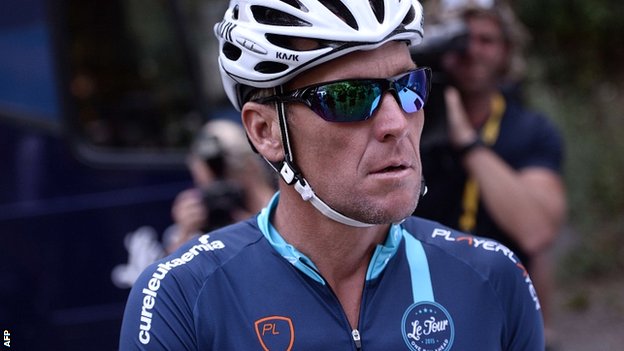
And Howman said he wondered if there were still riders doping on this year's Tour de France after former winner Lance Armstrong was stripped of seven titles following his admission he took performance-enhancing drugs.
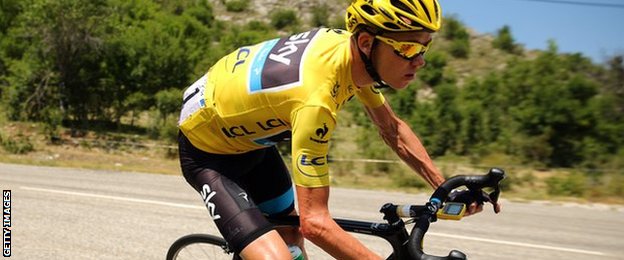
Leader Chris Froome has been questioned about his performance during this year's race but the Team Sky rider has denied doping.
Howman said that the numbers of riders doping had fallen "majorly" since Armstrong won Tours from 1999 to 2005, adding: "I have great respect for the way in which the UCI [world cycling's governing body] are now running their anti-doping programme."

Usain Bolt has said he is unsure how his pelvic injury will cope with the rigours of possibly running two 100m races at Friday's Anniversary Games.
The Olympic champion has raced once over the distance this year, clocking a pedestrian 10.12 seconds in April.
"I have worked hard in training so we will see how it is," said Bolt, 29.
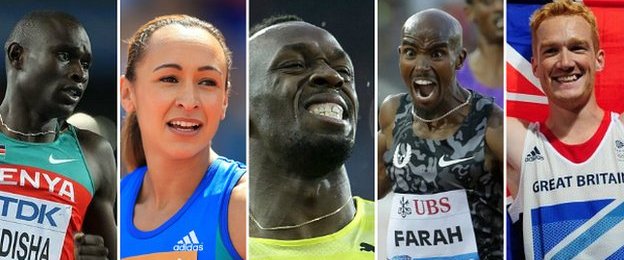
Britons Mo Farah and Jessica Ennis-Hill are also among a number of star names competing at London's Olympic Stadium this Friday and Saturday.
Sunday will see several of London 2012's Paralympic stars take centre stage as The Stadium hosts the final leg of the IPC Grand Prix Series.
GB stars will include Jonnie Peacock, who is hoping to break a new world record in the T44 100m, David Weir, Shelly Woods and Richard Whitehead.
The 32-year-old Farah will race in Britain for the first time since doping allegations were made against his coach Alberto Salazar last month.
The double Olympic champion, who will line up in the men's 3,000m on the opening night of the two-day Diamond League meeting, has not been accused of any wrongdoing and on Thursday Bolt said he felt sorry for the double Olympic champion.
Both athletes will be under the spotlight when they return to the scene of some of their finest achievements.
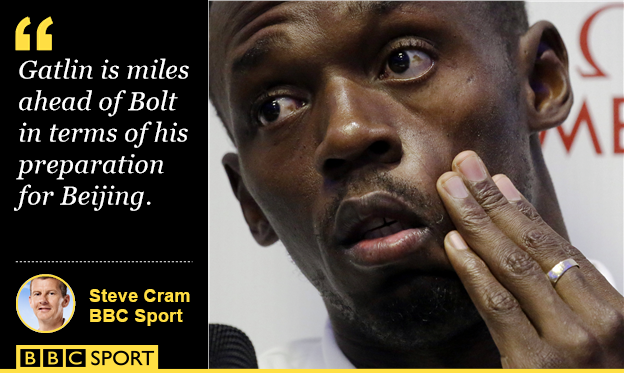
There are those who question whether six-time Olympic champion Bolt can successfully defend his 100m and 200m world titles in Beijing in August, particularly given the form of rival Justin Gatlin, the fastest man over both distances this year.
"I'm very excited for Beijing and a little bit nervous," added the world record holder, who will run in the heats on Friday and then the final just over an hour later, should he qualify.
"I set the bar quite high last time [in Moscow]. I am not going there to lose. I always ensure I am ready for Championships.
"For me it just takes one run to get to 9.7. It is the first 40m that is important and if I get that right, I know I'll be ok."
The Jamaican said he wanted to "put on a show" for the fans on Friday, saying: "Everywhere I go there are always a lot of Jamaicans in the crowd, especially in London, and I come here for the fans. They support me and I want to do great for them."
With none of the top three athletes of the season - Gatlin, Asafa Powell and Trayvon Bromell - in London, Bolt's biggest threats are likely to be Frenchman Jimmy Vicaut, whose season's best 9.86secs is equal fourth fastest of the year, and compatriot Kemar Bailey-Cole and American Ryan Bailey.

British 100m champion CJ Ujah and fellow Britons James Dasaolu, Richard Kilty and James Ellington will also be taking part in the 100m.
Organisers say tickets are still available for the event, which has not been a sell-out despite its world-class field.


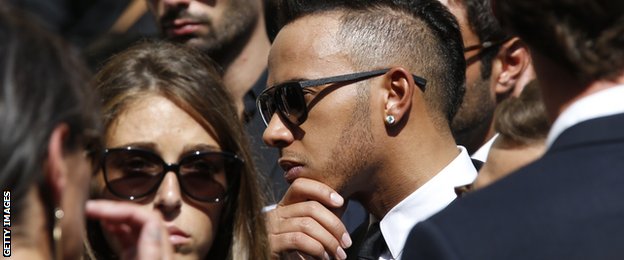
It is very hard for all of us in Formula 1 to grasp the magnitude of Jules Bianchi's death last week.
Many of us attended Jules's funeral in Nice on Tuesday, so it is all so clear in our minds as we arrive in Hungary this weekend for the final race before the summer break.
This year was already hard knowing Jules, who was a racer like all of us, was in hospital. We knew how serious his condition was, but obviously you were always hoping that he would pull through.
So to have heard that he is no longer with us; well, it is hard to believe in this day and age.
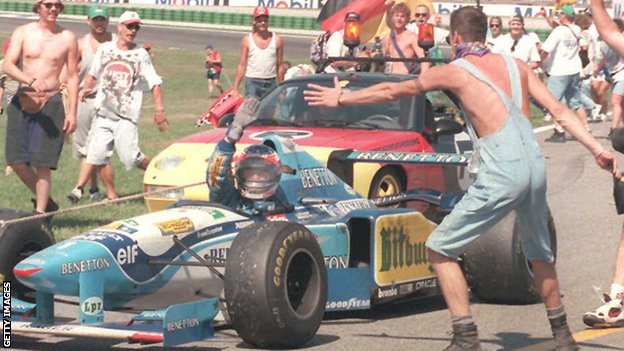
In my lifetime, three drivers' deaths have had a big impact on me. The first was Ayrton Senna back in 1994, when I was nine. Then later that year I saw a boy I knew called Daniel Spence die in karting. And now Jules.
Jules's funeral reminded me very much of Daniel's, the all-pervading feeling of sadness and loss. It was heartbreaking to see his family and friends in tears, hurting so much, and just knowing that they are going through the worst possible time.
Jules will be in all of our thoughts this weekend in Hungary but we will go out and race hard for him because, like him, we are all racers. That's what we do, what Jules did, and what he would want us to do.

Carrying on as normal, despite the shock

When someone is lost like that, of course it is a shock, but there is no question in my mind about carrying on in racing, no doubts about getting back in the car.
I have no fear. I'll just get in and drive like I always do - you can't let things like that affect you. And it will make no difference to my focus and commitment.
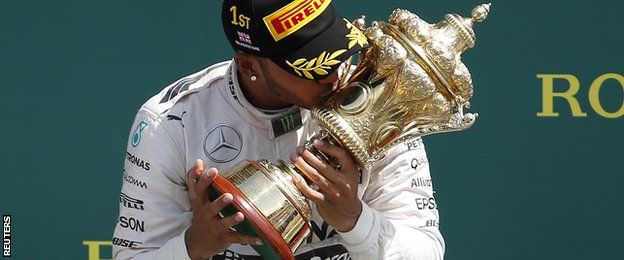
I am going to Hungary with the intention to win and to extend my championship lead, as always.
Hungary marks the halfway point of the season and I have to say that, from the perspective of my racing, it has been a pretty awesome year so far.


Croatia have been deducted a point from Euro 2016 qualifying Group H as punishment for a swastika painted on the pitch before a match against Italy.
Uefa also fined the Croatian Football Federation (CFF) 100,000 Euros (£70,000) and ordered their next two games to be played in an empty stadium.
Croatia are also barred from holding qualifiers in Split, which hosted the1-1 draw with Italy on 12 June.
The CFF claim the incident was an act of "sabotage" and can appeal.
Croatia remain top of Group H, a point above Italy, even with the deduction.
The top two teams from each group automatically qualify for next summer's finals in France.


Commonwealth Games silver medallist Nick Miller has broken the 31-year-old men's British hammer record with a 77.55m throw at a meeting in Sweden.
The 22-year-old's effort was a centimetre better than the previous record set by Martin Girvan in 1984.
Miller achieved the record with his first attempt at the Karlstad GP and it was enough for the Cumbria-born athlete to finished second in competition.
His previous best was 76.97m, set in California in May.


American Justin Gatlin ran the joint second-fastest time of 2015 to beat Asafa Powell and Tyson Gay in the men's 100m at the Diamond League in Lausanne.
The 33-year-old, who has served two doping bans, ran 9.75 seconds before next month's World Championships.
Powell and Gay both ran 9.92 seconds, while Usain Bolt was out injured, although the Olympic champion plans to defend his world title in Beijing.
Gatlin's countryman Gay and Jamaican Powell have also failed drug tests.
Gay, 32, served a one-year ban after testing positive for a banned anabolic steroid in 2013, while Powell, 32, served a six-month ban after testing positive for a banned stimulant in 2013.
Gatlin, who set the best 100m time of the year with 9.74 seconds in May, had an eight-year suspension halved to four years after testing positive for testosterone in 2006, five years after first failing a drugs test in 2001.
"I love this track," he said. "Last year I ran 9.79 seconds, and this year there was more competition.
"It's always good to face the best - it's like a heavyweight boxing match. That's what I want to do."